Showing posts with label Mystery Skype. Show all posts

Friday, October 10, 2014

1st Mystery Skype of 2014

On Tuesday, my class participated in their first Mystery Skype of the school year.  If you are unfamiliar with Mystery Skype, the concept is simple: two classes Skype with each other and try to figure out each other's location by asking only yes/no questions and using maps.  Students must keep up with "clues" they are given, narrow down possible locations, and guess the correct state and city (and sometimes the correct school--although we didn't get that far this time).  This geography activity is perfect for helping my students master their map skills and usually takes around 20 minutes to complete.

Here are the jobs I gave my students:
Greeter--This student greeted the other class politely and got the "game" up and running.  He/she then joined the Think Tank.
Inquirers--These two students asked yes/no questions of the other class and answered questions from the other class.  They sat in front of the computer camera the entire Skype call. 
Clue Keepers--These two students kept up with information from the other class and wrote clues down on the dry erase board.
Think Tank--A group of students who studied maps and worked together to create questions for the Inquirers. 
Runner--This student kept communication going between the Think Tank and the Inquirers.
Photographer--This student took pictures and video of all the groups/happenings.  He/she eventually joined the Think Tank.
Computer Mappers--These two students used the classroom computer to search maps online.  They worked closely with the Think Tank.
 
For their first Mystery Skype, the students did a wonderful job!  After the Skype session, we had a time of reflection.  I asked the students two questions: "What went well?" and "What can be improved?"  
 
I have to say, I agree with their assessment:
 
What went well?
  • We knew our cardinal/intermediate directions.
  • We were good sports.
  • We were cooperative.
  • We communicated well.
  • We tried to create good/effective questions.
  • Clue Keepers worked very well together and did a great job.
What can be improved?
  • We need to stay in our assigned spots.
  • Our volume needs to be lower.
  • We need to get better at using Google Earth and online maps to find locations.
To see a brief video of this session, click here:  1st Mystery Skype of 2014-2015

For more info, see my posts about previous Mystery Skype sessions: CLICK HERE.

Tuesday, March 19, 2013

Mystery Skype Update

I wanted to give an update on our Mystery Skype sessions.  You can check out how our first session went by CLICKING HERE.  We have learned a great deal since that first session and have made changes for improvement.  As of now, we've participated in eight Mystery Skype sessions; three of them were in Canada and the rest have been in the U.S. 

I changed my students' roles a little since the first Skype session.  During our second Mystery Skype, I allowed every child to come to the webcam and ask/answer a question--that was just too confusing and I wouldn't recommend it!  During our third Skype call, I designated three inquirers; this ended up being perfect for our group, so we stuck with that for the rest of the sessions.  My three kiddos would rotate and take turns asking questions.  My third inquirer also acted as a "runner."  It has worked well.
Here are our current rules, roles, and routine(s):

Skype Rules:
  • Listen carefully.  Whisper only.  Do NOT talk while the other class is talking or while someone from our class is asking a question.
  • Stay in your designated area and work on your specified assignment.
  • Keep track of clues.
  • Create possible questions.
  • Be polite when speaking to each other and the other class.  Always reflect Christ.
Skype Roles:
  • Greeter
  • Scribe (will write information/clues on the dry erase board)
  • Inquirers (will ask questions of the other class)
  • Photographer
  • Think Tank (will use maps/atlases)
  • Google Mappers (will use iPads or BYOD)
  • Computer Mappers (will use the classroom computer)
  • Closer (will end the call politely)
  • Mathematician (will use MapQuest to find distance between our locations)
Skype Routine:
  • Find the country/state or province/city of the other classroom by asking only YES/NO questions.  A "YES" answer allows the class to ask a follow-up YES/NO question.  A "NO" answer gives the opposing group the chance to ask a question.  (FYI, sometimes we didn't use the follow-up question format...the students would decide on that when the call began).
  • The runner could clearly see guesses and possible questions; no one was calling out. 
         
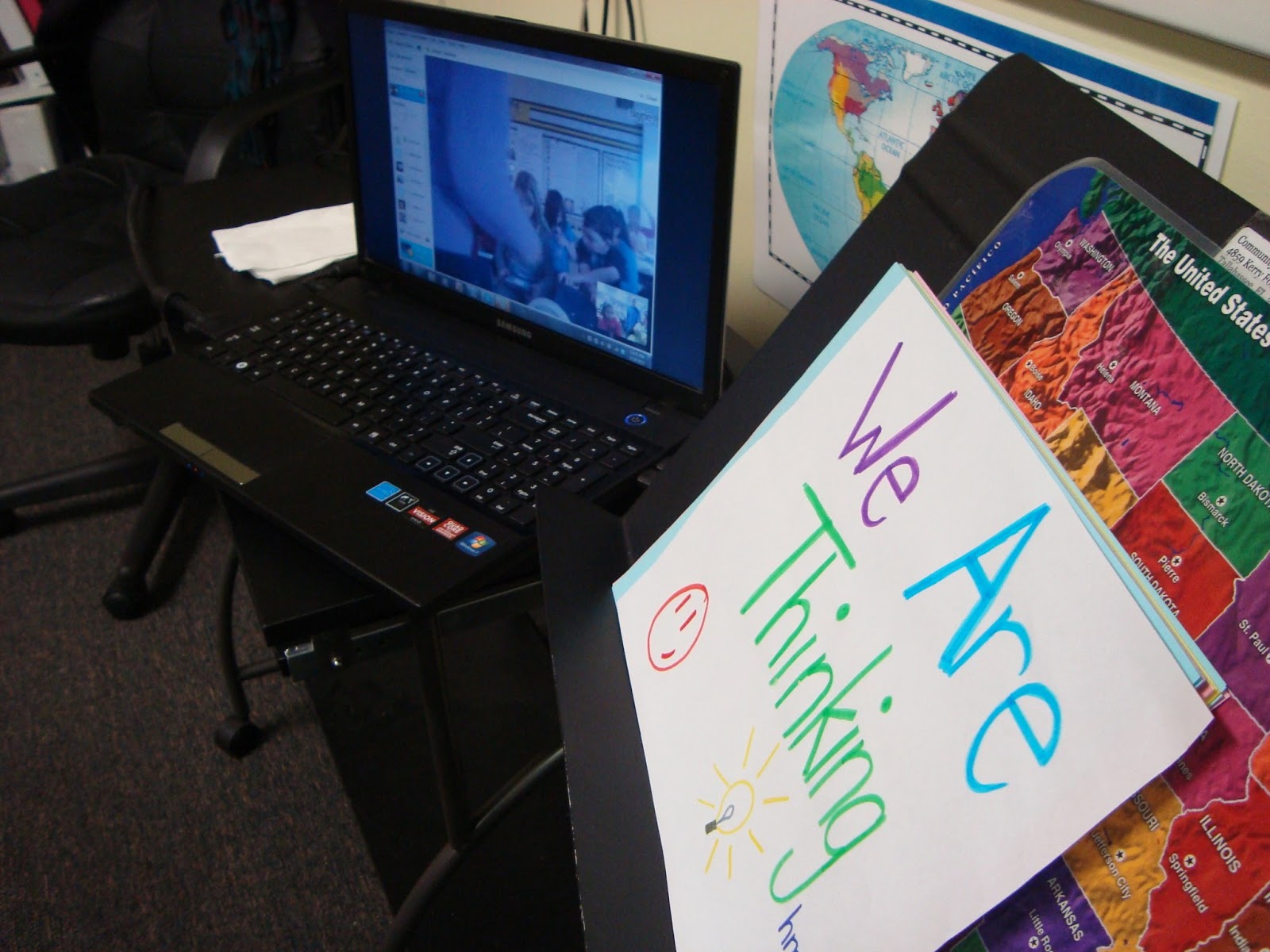
Cute picture we snapped from @KatyGartside's class!
        
We loved the idea so much, we used a "We Are Thinking" sign in our next Mystery Skype call. 
Possible Questions/Clues:
The students came up with these and we just posted them on the board during our Skype calls.
Finally, here are my goals for the students, along with a list of pre-requisites for Mystery Skype.  Also, I'll include a list of post-call activities. 
 
Mystery Skype Goals:
  • Practice geography skills (authentic experiences bring learning to life for students)
  • Improve communication skills
  • Develop good questions
  • Work together to accomplish a goal
  • Make connections with other students across the globe (overcome geographic boundaries)
  • Practice computer search skills
  • Collect data and use deductive reasoning
  • Become reflective
Pre-requisites:
  • Students will need to know facts about their state/city/school and be able to answer questions on those topics
  • Students will need to know how to read a map/atlas
  • Students will need to know how to conduct online searches and be able to assess a website for credibility
  • Students need to be able to use Google Maps and Google Earth
  • Students need to know how to conduct themselves in a group (e.g. etiquette/tact, listening skills, communication skills, etc.)
  • Students will formulate questions to ask of the other class
  • Students will need to be able to conduct an interview
  • Students will need to be able to use a digital camera to make image or video recordings
  • Students will need to have taken part in a simulated Mystery Skype with the classroom teacher
 
Post-call Activities:
  • Informal assessment--debrief by asking questions such as, "What worked well during the call?  What did not work well during the call?  What did you like the most/least?  What surprised you?  How can we improve for the next call?  What do you know now that you didn't know before the Skype call?  How is asking a question or being asked a question via Skype different from asking a question/being asked in the classroom?"
  • Write reflective blog posts/journal entries
  • Have students take a survey about their learning from the Mystery Skype session
  • Create a video recording of the debriefing session
  • Create a slideshow of the images collected during the call
  • Create an iMovie short film from the video clips taken during the call
  • For the teacher: host a parent/faculty presentation session about the activity


Friday, January 18, 2013

Our First Mystery Skype

On Tuesday, my class participated in our first Mystery Skype.  If you don’t already know, Mystery Skype is an activity in which two classes Skype and try to figure out where the other is located.  We guessed each other's state, city, and school.  This is done by having the students come up with clues about their location and asking yes/no questions.  Students must think about the clues they are given and then study maps in order to rule out certain places and make educated guesses.  This activity is student centered and the teacher acts as a facilitator.  
 Benefits of Mystery Skype:
  • Geography comes to life for the students.  It’s interactive; they learn about other states or countries in the world by having a conversation with the people who actually live there.  This is much more interesting and engaging than reading from a textbook!
  • With this activity, students are able to put to use their geography skills and see the value in knowing their cardinal/intermediate directions, how to read a map, etc.  I remember asking the students, “Do you see why it’s important to know where you are in the world?”
  • Students practice critical thinking skills.  They must brainstorm and create good questions for the other class.  They must use clues and deductive reasoning to figure out possible places where the other students are located.
  • Students practice communication skills.  The children must communicate effectively with those in their classroom and those on the computer in order to progress through the activity.
  • Encourages collaboration
  • Integrates technology and helps make global connections

Drawbacks of Mystery Skype:
  • It is easy for students not to participate and let someone else do all the work. 
  • It is difficult to hold each child accountable.

Mystery Skype is a wonderful activity.  However, I had some challenges during my first Mystery Skype and I’m going to share my honest reflections here.  I’ll also share my plan for improvement, as I’ll definitely be trying Mystery Skype again.
 
Everything I had read online about Mystery Skype beforehand gave me information on jobs/roles for the students so I mainly focused on that.  I made sure every child had a job and knew what his/her role was.  I’ll tell you the jobs I used, but know that I will probably change these for the next Skype session.  Here goes:
Greeter—Greeted the other class and shared a few clues about our location without giving it away
Orators—Asked/answered the questions and were the voice of the classroom (I didn’t want everyone shouting out answers, so I assigned two people to speak)
Inquirers—Came up with the questions to ask the other class.  They worked closely with the orators.
Typists—Two students were stationed at the computer to transcribe questions and answers.  They were taking the “minutes.”  
Google Mappers—Used maps on the iPads to try to piece together clues
 
Think Tank—Group of students who discussed the clues and tried to think through possible locations.  They were given maps to write/draw on.
Clue Keepers—Worked closely with the Google Mappers and Think Tank to keep up with clues.  They also sent information to the inquirers and orators.
Messenger—This student went from group to group, relaying information.
Photographer—Took pictures throughout the activity
Closer—Responsible for ending the call politely
Mathematician—Recorded the start/stop time of the call; when the activity was finished, this student used MapQuest to find the distance between our locations and the length of time it would take to drive from our school to their school.

I learned a great deal from this activity.  I, unfortunately, had made a lot of assumptions before our Skype call which caused me to be disappointed with my class’s participation in the activity.  First of all, I assumed they knew all the states and their locations.  They supposedly learned this last year.  However, they ended up having difficulty identifying locations on the map they were given.  I learned that I need to show maps every day and continue to talk about places in the world.  I can’t just say, “Oh, well they should have learned that last year” and not continue to reinforce the concepts.

I assumed my students knew how to search for information online.  I learned a few days ago, however, that their Internet search skills are limited.  I was also shocked to find out that they are not allowed to go on the Internet when they visit the computer lab for special area.  Instead, they focus on keyboarding.  I don’t have a set of computers in my classroom so I’ve never really had the chance to see many of my students try to navigate the Internet.  We will definitely be working on that!
I assumed that if each child had a job, they would take the task seriously and try to do their job well.  Negative.  I learned that when given a little bit of freedom, some of my students will take the opportunity to be silly.  At one point, I had a student holding a large map over his head and making random noises.  He wasn’t trying to help his classmates and wasn’t really listening to the other class.  He wanted attention and was trying to distract others.  I learned that I need to consider each child’s strengths and weaknesses and choose my students’ jobs carefully instead of randomly assigning them.  

My first Mystery Skype was definitely a learning experience and didn’t go as smoothly as I had hoped!  I had high expectations because my class is bright, polite, and usually very well-behaved.  They were nervous and excited though and neither of us knew what to expect.  The activity turned chaotic and confusing at times, which was frustrating.  

If I do this again:
  • I will practice before connecting with another class!  I will think of a country (or state) somewhere in the world and offer clues about the location to my students.  I will have them create questions to ask, examine maps, etc. and we will do a simulated “Mystery Skype” activity with just us.   
  • I will have my students come up with some behavioral rules/guidelines beforehand and make my behavioral expectations crystal clear. 
  • I will make sure my students know facts about their state/city inside-out!  They had a tough time coming up with clues for the other class to guess.
  • I will give more children the opportunity to come up to the computer, introduce themselves, and speak into the microphone.  During our first Skype, I had assigned only two students to speak.  Even though all my students could be seen in the background, I realize now that every child needed the opportunity to talk to the other class and next time, I’ll let them.     
I definitely have a better idea of how Mystery Skype should go.  I look forward to trying it out again!